

What Equipment is Used in Investment Casting?
Investment casting, or precision casting, or lost-wax casting, is an intricate and reliable process in manufacturing complex metal parts with exceptionally high precision. This process consists of several stages that each demand specific equipment necessary to reach the high standard for the production of parts used in industries such as aerospace, automotive, medical, and industrial machinery. In this article, we look at the different types of equipment that are necessary for investment casting and take an in-depth look at their roles in this highly detailed process.
1. Wax Injection Molding Machinery
The journey of investment casting starts with creating a wax pattern that becomes the core shape of the final cast. It is here that wax injection molding equipment comes into play: heating and melting a particular type of wax, followed by injecting it into the mold under high pressure.
Wax Injection Machine
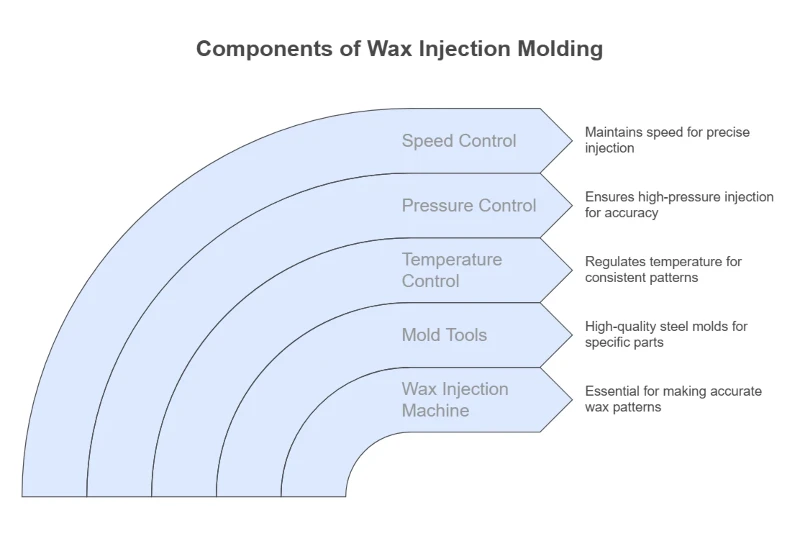
In investment casting, a wax injection machine will be important in the making of correct patterns of wax. These machines are usually designed with several multiple cavities that enable the manufacturer to make a number of wax patterns at one and the same time. Equipped with advanced controls, they ensure that temperature, pressure, and speed of injection are regulated for consistent and accurate patterns.
Wax Injection Mold Tools The mold tools involved in wax injection have high-quality steel molds that can withstand the temperature during injection. These are designed for specific parts and are mostly custom-made, based on the form and design of the casting. This stage involves lots of precision since any flaw on the wax pattern might affect the final casting.
2. Shell Building Machinery
After creating the wax patterns, the next process involved in investment casting is the formation of the ceramic shell, which is supposed to carry the wax pattern. In shell building, a number of layers are applied over the wax pattern using a refractory material in order to achieve a durable mold.
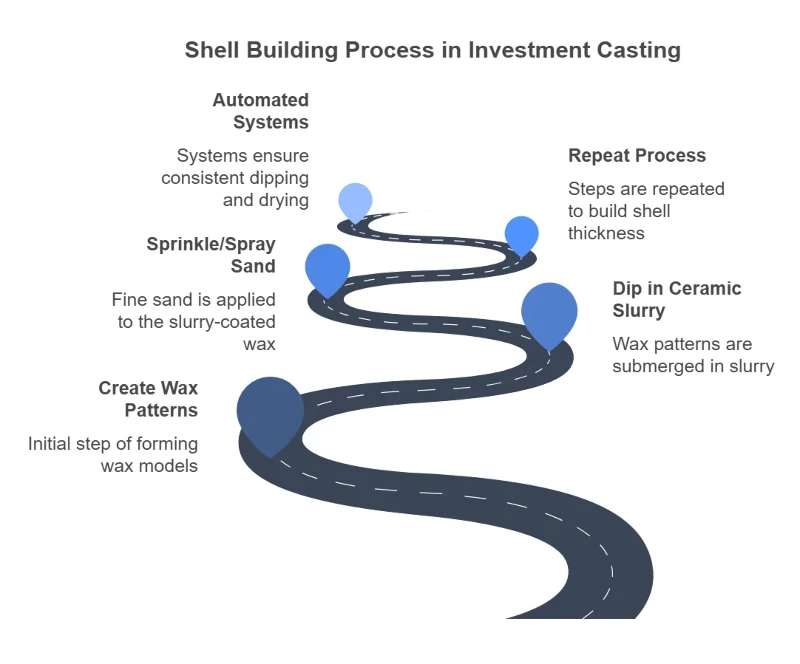
Shell Building Station Shell building equipment includes machines that allow for the precise application of the ceramic slurry and fine sand over the wax model. This is typically done by dipping the wax patterns into a liquid ceramic slurry, followed by sprinkling or spraying fine sand onto the wet surface. The process is repeated numerous times to build up a thick, hardened shell.
A shell-building station would typically be fitted out with automated or semi-automated systems that are capable of dipping and drying the slurry layers in a consistent manner.
Drying Oven
Every time a layer of ceramic slurry is applied, the shell has to be thoroughly dried before the next layer can be added. A drying oven is used to cure the ceramic material at high temperatures, ensuring that each coat bonds securely with the previous one. The temperature of the oven is very delicately controlled to avoid cracking the fragile ceramic shell.
3. Shell Hardening Machinery
The equipment for shell hardening must be such that the Mold is adequately strong enough to act as a receptacle for 'red hot' molten metals. The shell, after it attains construction, requires a hardening treatment carrying sufficient strength and rigidity pertaining to the casting process of the article.
Shell Hardening Furnace
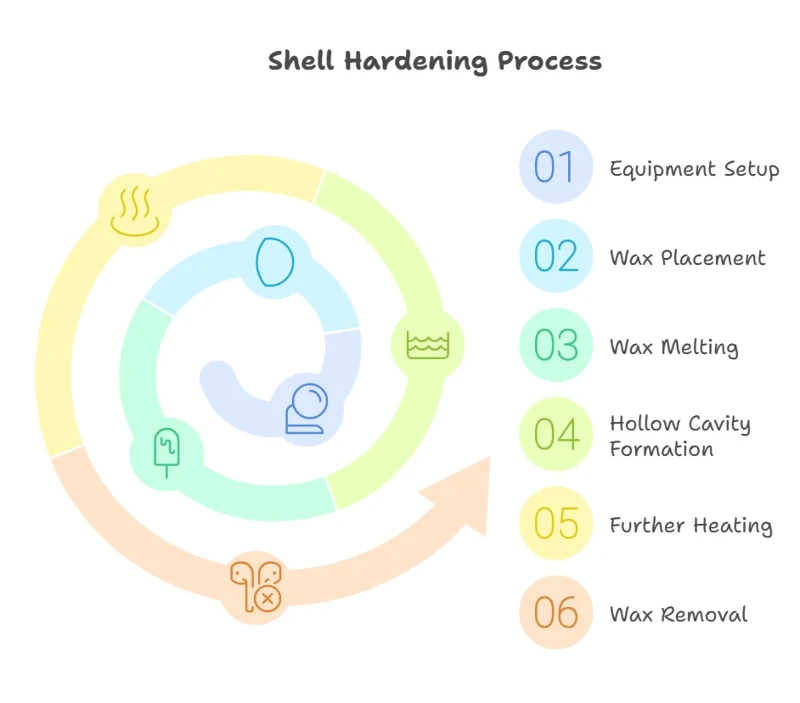
Shell hardening is a process that involves the use of a special furnace. Inside the furnace, the wax patterns are placed and, with the heat applied, wax melts after some time, thus leaving a hollow cavity inside the hardened ceramic shell. It is also known as dewaxing or burnout.
The furnace has to be heated at a temperature which can melt the wax-usually 900°F to 1,000°F-and must be fitted with an accurate temperature control device to avoid damage to the shell.
Burnout Furnace
Once the wax has been removed, the shell needs further heating to its optimal strength. A burnout furnace is used to fully burn out any remaining wax and to ensure the ceramic shell has a fine, smooth surface, which is completely hardened and contamination-free.
4. Metal Melting and Casting Equipment
With the shell fully formed and hardened, the next step is to melt the metal that will be poured into the mold. This stage involves specialized equipment that may melt metals to exact temperatures and pour them into the mold with speed and efficiency.
Induction Furnace
The induction furnace is the most used in melting metals by investment casting. In induction furnaces, the principle of electromagnetic induction is applied to generate heat and melt metals, allowing great preciseness in temperature and speed. Most in demand is induction furnaces for metals like aluminum, steel, and titanium, which are also commonly dealt with in casting. This helps minimize the possibility of any contamination in the molten metal, which is so highly desirable for quality casting.
Electric Arc Furnace - EAF
In large-scale operations, it may employ an electric arc furnace (EAF), or specific alloying. An electric arc furnace employs electric arcs for the melting of large amounts of metal. It is useful in melting high-melting-point metals like stainless steel, cobalt, and nickel-based alloys.
Ladle for Pouring
Transference of molten metal, from furnace to mold, happens by the use of the pouring ladle. It is developed and constructed to securely hold and safely pour molten metals with proper correctness to a ceramic mold. This utensil exists in different shapes and sizes; the actual one will be determined in consequence to the size of casting that will take place: most are typically fitted out with a handle and spout arrangement to allow more precise work of pouring.
Vacuum Pouring System
Some of the sophisticated investment casting processes, notably in areas like aerospace, may use vacuum pouring to make certain that molten metal is introduced under specified conditions. The vacuum pouring facility, through partial evacuation of air in the pouring chamber, prevents entrainment gas bubbles that usually affect casting quality.
5. Cooling and Unmolding Equipment
After pouring molten metal into a shell, it needs time to cool down and solidify. This step is as important as all the others and requires special machinery to make sure that cooling occurs in a uniform fashion, allowing for safe mold removal.
Cooling Pit
Afterwards, the metal is allowed to cool off in a cooling pit once the pouring has been done. A cooling pit is a larger, temperature-controlled area wherein mold would be allowed to cool in their own good time. Cooling in due course is very important; this helps the metal in solidifying with even dimensions; otherwise, warping may occur, or even worst, cracks in the castings. For more sensitive materials, controlled cooling systems may be employed to monitor and regulate the temperature. Shell Removal Equipment Once the metal has cooled and hardened the ceramic shell must be removed. This is often accomplished mechanically or manually. Sometimes the shell is removed by an abrasive blasting system and sometimes the mold is shattered by a special vibrating machine or hammering technique. Following shell removal the casting is thoroughly cleaned.
6. Finishing Equipment
The final step after the removal of the mold, revealing the casting, involves finishing and cleaning of the part. This is a necessary part of the process for quality in the casting to make sure it is defect-free. Grinding and Polishing Machines The surface is smoothened by the use of grinding and polishing equipment, removing all imperfections and giving a fine edge. In most cases, high-precision grinding machines are used for giving the final dimensioning to the casting, and the polishing machines provide a nice, smooth shine. Shot Blasting Equipment The shot blasting equipment is used on the castings with intricate surfaces to remove the remaining fragments of the shell and clean the surface. In shot blasting, the steel or ceramic pellets are shot at very high speed against the casting for cleaning and smoothening. Ultrasonic Cleaning Systems Ultrasonic cleaning systems are used to remove contaminants from complicated geometries for some castings, especially in aerospace and medical applications. Ultrasonic cleaning uses high-frequency sound waves to agitate a cleaning solution and remove debris from hard-to-reach areas.


