How is an investment used in casting?
Casting is, in fact, a mode of giving shape to metal by casting it in a mold; an intrinsic part of industries that are as dispersed as aerospace and automotive to jewelry-it can offer both precision and versatility. Well, investment casting is manifold; investment casting is such a highly sophisticated technique which can brag about superior detail and a load of advantages. But the question is just how investment is used in this process called casting. In this article, the vital role of investment in this process, the significance of investments to make a good casting, and why the same is indispensable to a few industries will be talked about.
What is Investment Casting? Investment casting, also known as lost-wax casting, is a manufacturing process in which a wax model of a part is coated in a special ceramic material-the "investment"-then heated to melt out the wax. The remaining ceramic shell forms a mold into which molten metal can be poured at very high temperatures. The investment itself plays a very important role in ensuring that the casting is both precise and strong.
The process is well known for creating very detailed and intricate parts, which often have complex geometries that no other method can produce.
Casting - the Investment Role
The investment in investment casting is the material used for the mold that forms around the original model. A wax model to exact dimensions of the part required is created during investment casting, covered with a special ceramic shell to form a durable mold. The roles of this investment are as follows:
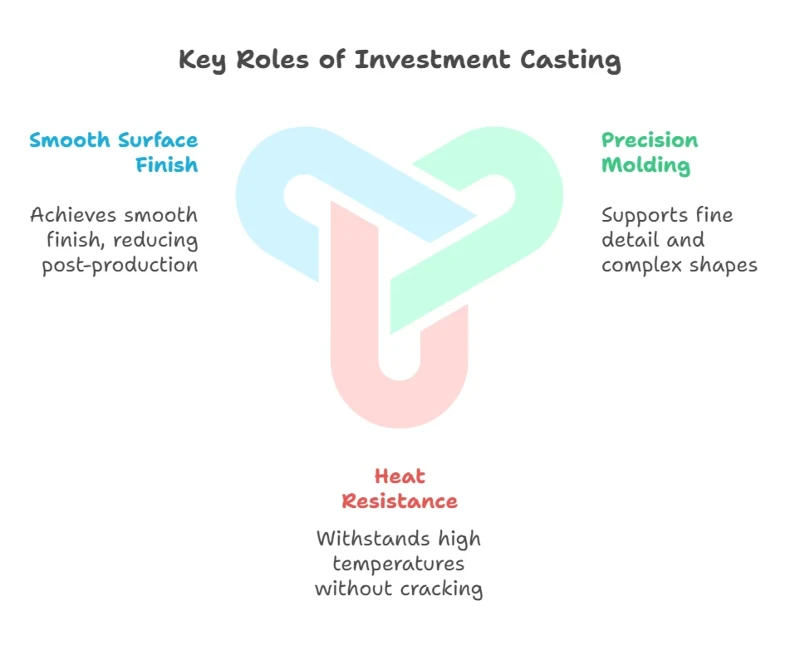
Precision Molding: The investment material must support very fine detail. It enables the casting to reproduce complex shapes and fine features that may be difficult or impossible to achieve with other methods of casting.
Heat Resistance: It has to bear the heat from the molten metal at very high temperatures, often greater than 1,600°F (870°C). The shell must be strong enough not to crack or lose shape when such temperature levels are reached.
Smooth Surface: The investment also helps achieve a smooth finish on the casting, reducing the need for post-production finishing. This is particularly important in industries like aerospace, where surface integrity is critical.
Choosing the Right Investment Material
The investment material plays the most important role in deciding the quality of the cast. Normally, the investment material used in casting is a mixture of fine sand, silica, and other bonding agents. The composition of investment material varies for different metals to be cast, on complexity of the part and required surface finish.
Investment of Ceramic Shell
In most investment casting procedures, a ceramic shell investment is used. It's usually built up in layers, where each layer has hardened and then strengthened before the putting on of the next. It normally consists of the following process:
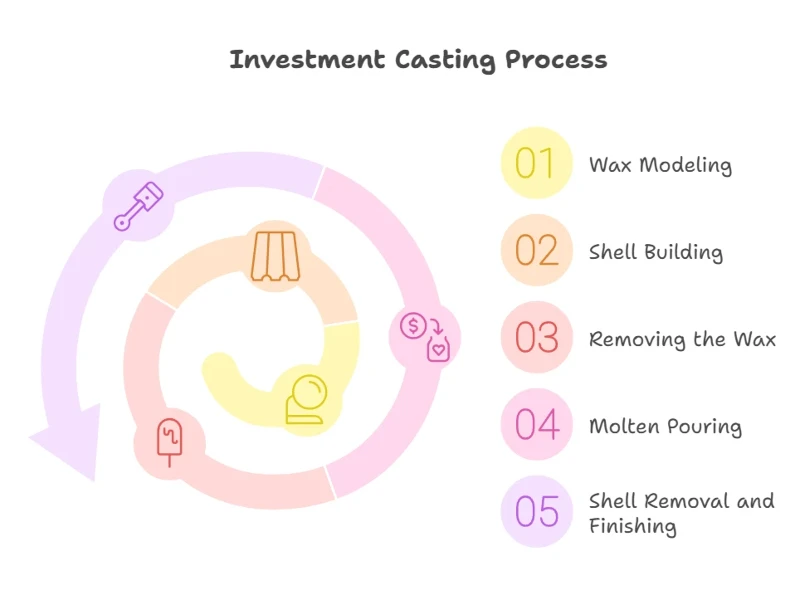
Wax Modeling: A wax model of the desired part is created first. This can be done through molding or injecting molten wax into a pre-made mold. Then, cool and harden the wax model.
Shell Building: The wax model is dipped in a fine ceramic slurry, after which sand particles are sprinkled over it. The process of dipping in slurry and sprinkling sand particles over it is done many times to achieve thick layers of ceramic shell around the wax model. Every layer dries and hardens before another layer is applied.
Removing the Wax: The complete assembly is then heated in an oven when the desired thickness of the shell has been built up. This causes the wax to melt and drain away, leaving behind a hollow ceramic shell.
Molten Pouring: The shell opens up for receiving hot molten metal after removing wax from it. Ceramic shell is again heated so that its temperature is at the right degree for receiving metal in the molten state. It is now filled with the molten metal, which cools down in it and becomes solid.
Shell Removal and Finishing: After the casting cools, the ceramic shell is broken away to reveal the metal part. Any added finishing steps, such as sanding or polishing, may be performed.
Advantages of Investment Casting
Investment casting has a number of advantages that make this technique preferred in application for some industries:
High Precision: The capability to reproduce complex geometries with minimal post-processing is a major advantage. Investment casting allows for tight tolerances, often to within a few thousandths of an inch, reducing the need for secondary machining.
Material Versatility: Investment casting can be done on a wide range of materials, from stainless steel and aluminum alloys to specialized metals like titanium and nickel alloys. This makes it ideal for high-performance applications in sectors like aerospace and medical devices.
Reduced Waste: The efficiency of the casting process is such that there is very little material waste compared to other methods, such as sand casting or die casting. The investment mold is reusable to some extent, which further reduces material costs and waste.
Unlike other methods of casting that may have features that are internally complicated, no core supports are required for investment casting. This will lead to better design flexibility, especially for those parts that are difficult to cast through other methods.
Investment Casting Saves Much Work after Casting is Done: Many investment-cast parts are produced with near-net shapes that little or no additional machining and finishing needs to be done; these save time and decrease related costs of secondary operations.
Applications of Investment Casting
Investment casting finds broad applications in various industries due to the high accuracy, strength, and complex details of the parts manufactured. The common areas of application include:
Aerospace
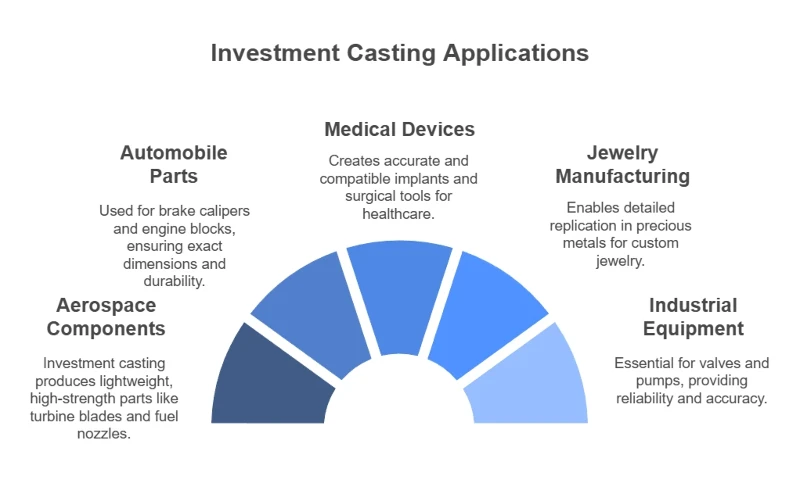
The aerospace industry requires parts that are lightweight and very strong. Investment casting is best suited for the manufacture of complex, high-performance components such as turbine blades, fuel nozzles, and engine parts. A few of these parts have extremely high temperature resistance and thus require superior strength and durability, making investment casting perfect for achieving such strength for these applications.
Automobile Industry Investment casting is also used in very wide areas of the automobile industry, especially for those parts that must be prepared to very exacting dimensions, such as brake calipers, transmission components, and engine blocks. These parts have to be lightweight but strong enough to bear high levels of tension and temperature. The achieved precision by investment casting offers these parts the best fitness, reducing post-production adjustments. Medical Devices Likewise, the casting of investments is also vastly applied in medical implants and surgical tools. Parts to be produced, such as joint replacements, surgical instruments, and prosthetics, demand accuracy and compatibility within the human body. The investment casting process thus enables manufacturing parts that are needed to meet specific needs inside the human body with strength and functionality. Jewelry Manufacturing The procedure for investment casting is very helpful in fine jewelry where very minute detail is to be carried out that cannot be achieved through other conventional means. This replicating of minute details with the availability of casting into gold, platinum, and silver has made this investment casting technique an indispensable one for a jeweler when it comes to reproducing minute detail in a custom-made piece. Industrial Equipment Some of the major parts used by industries are built using the investment casting procedure-things like valves, gears, and pumps. The accuracy provided by the process has become really important to have such components work successfully in their specified manner.