

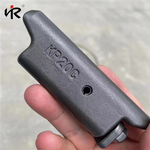


Hot Forging Parts
China Hot Forging Parts Manufacturers Factory Suppliers
We specialize in producing all kinds of Hot Forging Parts products, mainly Forge Bucket Adapter, Forging Ripper Teeth, Forged Bucket Teeth, Agricultural Machinery Wear Parts, Forestry Machinery Waer Parts, Forged Mechanical Fastener, Coal Mining Cutting Picks, etc.
HANRUI STEEL CUSTOMIZATION was established in 2009, boasting over 10 years of manufacturing experience, can provide customers with perfect solutions.
Our market is mainly concentrated in countries such as the United States, Australia, Canada, Finland, Belgium, Bulgaria, Germany, Japan, United Kingdom, Netherlands, Sweden, etc. We have established long-term cooperative relationships with customers around the world.
Company Advantages
Well-Experienced
HANRUI STEEL CUSTOMIZATION was established in 2009, boasting over 10 years of manufacturing experience. With a dedicated team casting engineers, and mechanical designers, we are committed to offering solutions to the steel accessory challenges faced across various industries.
Large Scale
With shares in two investment casting bases, one sand casting base, and two forging bases, we offer comprehensive one-stop services to our customers. From initial design and development to the delivery of flawless steel parts, we ensure a seamless and efficient process.
Advanced Production Equipment
We are a full-service company providing complete design, R&D, production and sales services. Our production workshop is equipped with the most advanced equipment. Innovation, powerful technology, and expertise make our equipment highly automated with various parameters that can be adjusted to meet the needs of most applications in the industry.
24-hour Online Customer Service
We have an experienced and professional customer support team to provide flexible service to customers around the world. Our customer service is available online 24 hours a day. After receiving the service information or feedback from the customer, we will reply and address the feedback in the shortest time.
Global Sales Network
Our market is mainly concentrated in countries such as the United States, Australia, Canada, Finland, Belgium, Bulgaria, Germany, Japan, United Kingdom, Netherlands, Sweden, etc. We have established long-term cooperative relationships with customers around the world. In addition, we also provide OEM/ODM manufacturing services to many customers.
Customized Services
We welcome product customization, and our team is capable of developing new products or providing technical solutions tailored to customer requirements. lf you have any special request, pls send us the details.


Hot forging is a metal shaping process that involves heating a malleable metal part, called a billet or workpiece, to a temperature of about 75% of its melting point, and then working it into a predetermined shape using processes such as hammering, upsetting, or pressing.
The use of hot forging reduces the amount of force that is necessary to shape and mold the workpiece. Heated steel has better flow, which makes it ideal for open and closed die forging. Additionally, the heating process anneals a workpiece and relieves its stress making it ready for further processing.
With hot forging, the workpiece is heated to a point above its recrystallization temperature. The process of recrystallization deforms grains of the crystal structure, which are replaced by stress free grains that grow until the original grains are gone. It is used in steel forging to eliminate the effects of strain hardening. The recrystallization temperature is one third to one half the melting point of the steel.
Hot forging makes it possible to precisely adjust the fine microstructure of the steel. The strength and durability of the metal can be clearly defined and is used in manufacturing processes with high loads, both static and dynamic, that place demands on products.

Because the forging process occurs at high temperatures, the plastic metal is ductile and easily molded. Intricate shapes and designs can be created during hot forging, unlike cold forging where this can be extremely difficult. If you're looking to manufacture customized metal pieces, hot forging is the best option because of its malleable state before hardening. This method is ideal for creating 3-D and complex shapes.
Unlike cold forging, which sometimes requires the extra step of heating the outside of the metal afterward to give it the right properties, the surface of the metal that has been forged through high temperatures is ideal for most types of finishing work.
Hot forging is also ideal for metals with a high formability ratio, because the integrity of the metal isn't compromised by the high heat. These metals can be easily shaped without seeing any defects in the metal, making them both strong and ductile.
Our Hot Forging Parts
Forge Bucket Adapter
A forge bucket adapter is a pin that fits bucket teeth, which are an important part of construction machinery excavators. The teeth are made by applying pressure to a heated steel billet between forging dies, which deforms the billet to achieve the desired shape and mechanical properties. This process improves the bucket teeth's organizational structure, making them more wear-resistant and longer lasting. Forged bucket teeth also offer high impact strength and better wear resistance.
Forging Ripper Teeth
Forging Ripper Teeth are an essential piece of kit for all minis and 360 degree excavators, and are used to make light work of hard, compacted, or rocky ground. Ripping ground prior to digging will greatly reduce wear and stress on both bucket and machine, and speed up cycle times. Ripper tips are suited for heavy duty rippers to maximize performance suited to the toughest and harshest of terrain.
Forging Ripper Teeth are tougher, and have longer wear life, but cast bucket teeth has good properties and cheaper. Forged steel is a material resulting from alloying iron and carbon under extremely high pressure. Forged steel has less surface porosity, a finer grain structure, more tensile and fatigue strength, and greater ductility than any other processed steel.
Forged Bucket Teeth
Bucket teeth are an important part of excavators for construction machinery. They are fitted with an adapter using a pin and are used in a hard environment, so wear-resistance is important. Digging buckets fitted with teeth are ideal for digging through and breaking up compact materials like soil and sedimentary rock. The teeth also work as wear parts and can be replaced when they are worn down, and thus increase the service life of the bucket.
Forged bucket teeth are a manufacturing process that uses a forging machine to create bucket teeth from steel billets. The process involves applying high pressure and high temperatures to the billet, which deforms it plastically to achieve the desired shape and mechanical properties. The forging process improves the grain flow of the steel, which enhances the bucket teeth's mechanical properties.
Forged Mechanical Fastener
Forged mechanical fasteners are made using heat and pressure to shape raw metal materials into nuts, bolts, and other fasteners. The process of using heat to soften metal and make it easier to shape is called forging, which gets its name from blacksmiths forges. In the past, blacksmiths would beat hot metals into shape with a hammer, but today the hammer is a mechanical device and the forge has been replaced by an induction heater.
Applications of Hot Forging Parts
Hot Forging Parts is predominantly used for automotive forging applications. Wrought aluminum alloys are on the rise due to the increasing lightweight construction demands; the use of magnesium is rare.
In the volume segment, components are forged in mostly small to medium series under closed die forging process. This enables the use of most automtive componets with high strength and working performace.
A number of typical automotive forgings are listed below. The examples are applicable for both passenger cars as well as commercial vehicles:
● Engine parts: Piston, connecting rods, cams, camshafts, crankshafts, valves, distributor housings, balance shafts
● Driving gear: All types of pinions, synchronizer rings, CVT, …
● Powertrain: Flange yokes and peg carriers, wheel hubs, driving shafts, universal joints, joint discs
● Undercarriage: Wheel carriers, axle journal, pivot bearings, axle stub, ball stubs, steering levers, steering levers, front axle beams, wishbones, …
● Brake system: Brake plates, brakes carriers, brake cylinders, brake handles
● Fuselage components such as fittings for doors and wings, ribs, window frames
● Engine with turbine blades, propulsion cone, discs, control levers
● Fittings and guide rails for the empennage
● Landing gear: Carrier, fasteners, pins
● Rotor systems: Fittings, rotor head, gearbox cover
In the aerospace sector, besides steel forgings, high-strength and temperature resistant special materials such as nickel-based and titanium alloys are used, as well as lightweight construction materials such as wrought aluminum alloys and magnesium.
Hot forging is not limited for automotive and aerospace applications. Furthermore, there are also some other important application fields in which hot forgings can showcase their strengths: Construction industry, Mechanical engineering, Agriculture, Defense industry, Steel construction, Offshore Industry, Sanitary sector, Precision engineering and watchmaking industry.
Maintenance Tips for Hot Forging Parts
Here are some maintenance tips for hot forging parts:
Check for die wear: Look for cracks, chipping, excessive wear, surface finish, dimensional inaccuracy, misalignment, and poor material flow.
Repair minor damages: Repair any minor damages promptly.
Store and handle equipment properly: Don't overuse equipment.
Have access to essential parts: This allows you to rapidly address any malfunctions.
Our Factory
We have a fully automatic CNC production line, and are committed to providing customers with the best products and services.


Frequently Asked Questions
Q: What factors need to be considered when Hot Forging?
Cooling. If the metal cools to a temperature lower than the minimum threshold, it completes the forging. The metal must be reheated if this occurs before achieving the final shape.
Tolerances. Dimensional tolerances with hot forging are less precise than cold forging.
Dies. Hot forging dies are custom-made to the customer's part specifications.
Q: What are the advantages and disadvantages of Hot Forging and Cold Forging?
Hot forging. Increased ductility for more complex parts and allows for more options for customization
Cold forging. Creates no waste, requires little to no finishing work, maintains dimensional accuracy, and results in high surface quality.
Disadvantages of hot and cold forging include:
Hot forging. Additional cost for heat treatment, less precise dimensional tolerance, risk of warping
Cold forging. Few options for customization, risk of residual stress, may require heat treatment
Q: Cold, Warm and Hot Forging: What's the Difference?
Cold forging involves either impression die forging or true closed die forging with lubricant and circular dies at or near room temperature. Carbon and standard alloy steel forgings are most commonly cold-forged. Cold forged steel parts are generally symmetrical and rarely exceed 25 pounds. The primary advantage of cold forging steel is the material savings achieved through precision shapes that require little finishing. Completely contained impressions and extrusion-type metal flow yield draftless, close-tolerance components. Production rates are very high with exceptional die life. While cold forging usually improves mechanical properties, the improvement is not useful in many common forging applications and economic advantages remain the primary interest. Tool design and manufacture are critical.
WARM FORGING:
Warm forging has a number of cost-saving advantages which underscore its increasing use as a manufacturing method. The temperature range for warm forging of steel extends from above a household oven temperature to below the recrystallization temperature, which is about 800 to 1,800 degrees Fahrenheit, depending upon the alloy. However, the narrower range of from 1,000 to 1,330 degrees Fahrenheit is emerging as the range of perhaps the greatest commercial potential for warm forging of steel alloys.
Compared with cold forging, warm forging has the potential advantages of reduced tooling loads, reduced forging press loads, increased steel ductility, elimination of need to anneal prior to forging, and favorable as-forged properties that can eliminate heat treatment.
HOT FORGING:
Hot forging is the plastic deformation of metal at a temperature and strain rate such that recrystallization occurs simultaneously with deformation, thus avoiding strain hardening. For this to occur, high workpiece temperature (matching the metal's recrystallization temperature) must be attained throughout the process.
A form of hot forging is isothermal forging, where materials and dies are heated to the same temperature. In nearly all cases, isothermal forging is conducted on superalloys in a vacuum or highly controlled atmosphere to prevent oxidation.
Q: Why Iron, along with its alloys, are almost always hot forging?
If work hardening progresses, hard materials (such as steel and iron) will become more difficult to work with, and
It is a more economical option to hot forge metals such as steel and then follow with heat treatment processes as metals such as steel can be strengthened through other processes (and not necessarily just cold working processes).
Q: What is the average temperature at Hot Forging?
Aluminum (Al) Alloys - 360° (680°F) to 520°C (968°F)
Copper (Cu) Alloys - 700°C (1 292°F) - 800°C (1 472°F)
Steel – up to 1 150°C (2 102°F)
Q: How to Indentify Hot Forging Process?
TH = 0.6 x TS (TS: Melting temperature of the material – all figures in K)
If the process temperature is above TH, the process is defined as hot forging. This doesn't necessarily mean that the material needs to be heated. In low-melting metals (e.g. lead), recrystallization occurs at room temperature.
The characteristic effect of hot forming, is the significant material strength reduction (yield stress) at temperatures above TH. The forming component becomes a "doughy" consistency.
Recrystallization – the new formation of the metal crystalline lattice structure – is responsible for this. Through the degradation of the existing strain hardening (dislocation density) in the metal, the mobilization of dislocations (thermal activation) and the interchanging recovery and recrystallization processes occurring during and after the forging step, it is possible to achieve very high formability. Thus, hot forging is used when the goal is to achieve complex 3D geometries via forming. In addition, it enables the processing of difficult-to-form materials, which can be formed only with limitations when cold. Due to the strength reduction under hot forging conditions, the force and work demand of the processes can be lowered in comparison to cold forming.
The recrystallization is responsible, through the complete reformation of the microstructure, possibly multiple times, for the formation of a relatively fine-grained microstructure. It exhibits the optimal combination of strength and ductility. This circumstance qualifies hot forging as one of the most important manufacturing processes for the production of highly stressed safety components.
Q: How Does Hot Forging Happen?
Recrystallization occurs simultaneously with deformation, thus avoiding strain hardening. For this reason, and for best results, the forging temperature must be maintained throughout the entire process above a specific minimal, depending on the alloy. This condition avoids as well the risk of lack of forgeability, which leads to cracks as the ductility may be seriously reduced at lower temperature. The forging sequence is subsequently limited in time to respect these temperature limits.
If forging is not completed when the lower limit is reached, reheating is required when possible, or the part must be considered as forged, and finished by other means. The required interval of temperature for hot forging process is so important that all toolings are preheated to limit the loss of temperature of the component during the forging step. This had led to design a very accurate and specific process for closed die forging called “isothermal forging”.
During isothermal forging, the tools (actually dies) are kept heated at the required forging temperature. This concept however is applied very differently, depending on the type of the material, thus on the forging temperature itself. The material grade used for the dies must effectively keep the high mechanical properties required to deform the component material at the forging temperature.
Q: What Are the Best Materials for Hot Forging?
Most of the steel alloys are almost always hot forged, because as work hardening on hard materials advances, their deformation becomes more and more difficult. Furthermore, it is much more economically interesting to hot forge metals such as steel and then perform a heat treatment.
Q: Which Industries Can Mostly Benefit from Hot Forging?
Q: What are some factors to consider when choosing hot forging?
Q: Is hot forging expensive?
Q: Is cold forging stronger than hot forging?
Q: What metals can be hot forging?
Q: How hot forging is done?